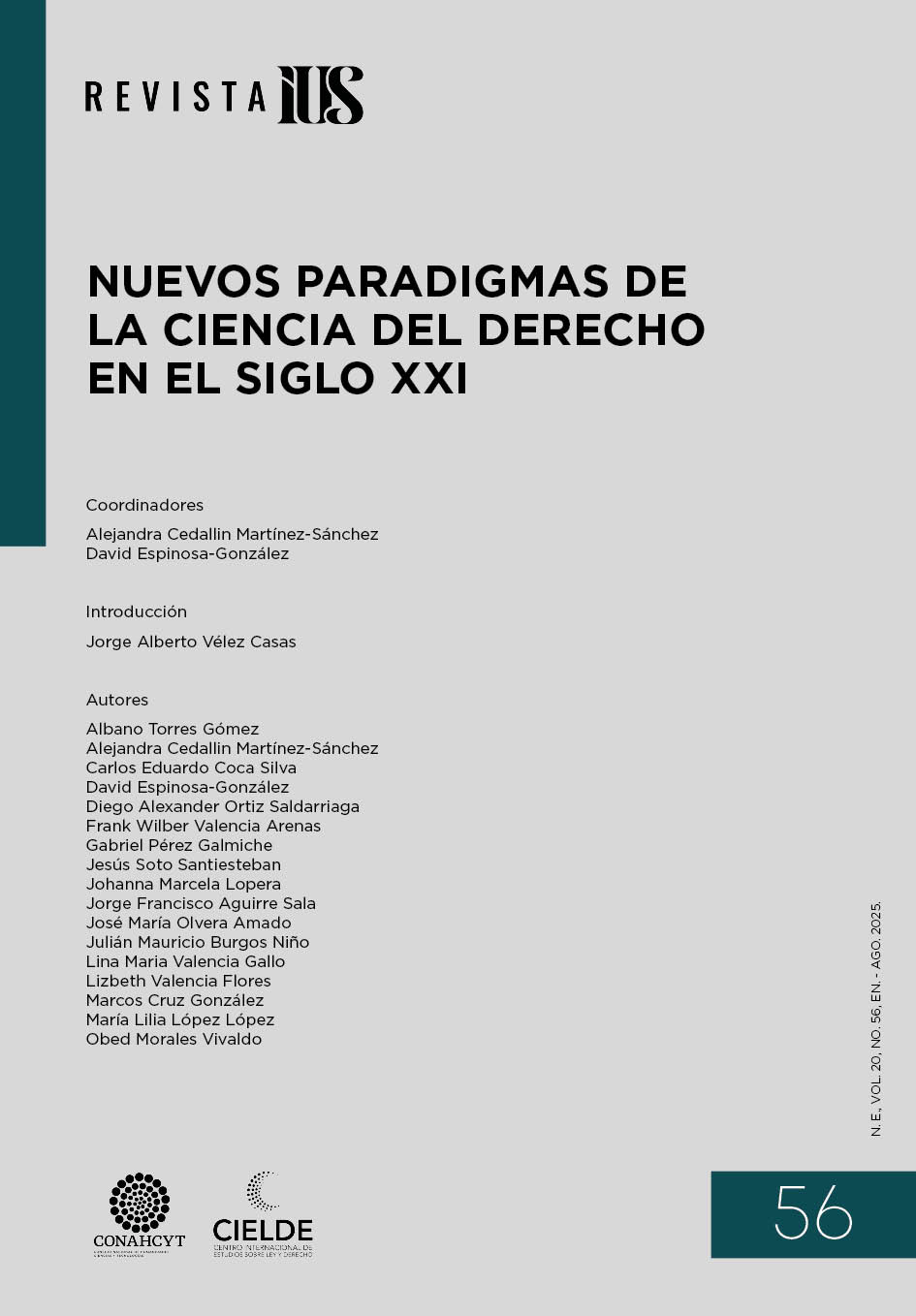
Implicaciones éticas de la utilización de la inteligencia artificial (IA) en la administración de justicia de Colombia
DOI:
https://doi.org/10.35487/rius.v20i56.2025.1062Abstract
This article analyses the ethical implications of using artificial intelligence (AI) in the administration of justice in Colombia. It examines its impact on judicial processes, the ethical principles that should govern its implementation, and the concerns arising from its application in decision-making. AI is presented as a support tool to optimize judicial management, ensuring greater efficiency and legal certainty; however, issues related to transparency, accountability, and the protection of fundamental rights persist. It is concluded that AI cannot replace the judge's role but should be used as an auxiliary mechanism within a clear normative and ethical framework. The need to develop regulations that balance technological benefits with respect for democratic and justice principles is emphasized.
Downloads
Downloads
Published
Issue
Section
License
Copyright (c) 2025 Lina María Valencia Gallo, Julián Mauricio Burgos Niño, Diego Alexander Ortíz Saldarriaga, Frank Wilber Valencia Arenas , Johanna Marcela Lopera

This work is licensed under a Creative Commons Attribution-NonCommercial-ShareAlike 4.0 International License.
Revista IUS, published by the Legal Sciences Institute of Puebla A.C., is distributed under the Creative Commons Attribution-NonCommercial 4.0 International (CC BY-NC 4.0) license.
We authorize collaborators to upload a copy of their published work on their personal websites or any Open Access repository, provided that Revista IUS is specifically cited as the original source, indicating the year and issue of the respective example and adding the link to the webpage on which this publication can be freely consulted in toto and without charge: http://www.revistaius.com
Readers are free to:
Share, copy and redistribute the material via any medium or format.
The licensor cannot revoke these freedoms as long as you follow the license terms.
Under the following terms:
Attribution: You must give appropriate credit, provide a link to the license, and indicate if changes were made.
You may do so in any reasonable manner, but not in any way that suggests the licensor endorses you or your use.
NonCommercial – You may not use the material for commercial purposes.
If you remix, transform or build upon the licensed material, its distribution is not permitted.
Charges for managing articles: Revista IUS will not charge for receiving, processing or publishing articles (Article Processing Charge, or APC) submitted by authors.